
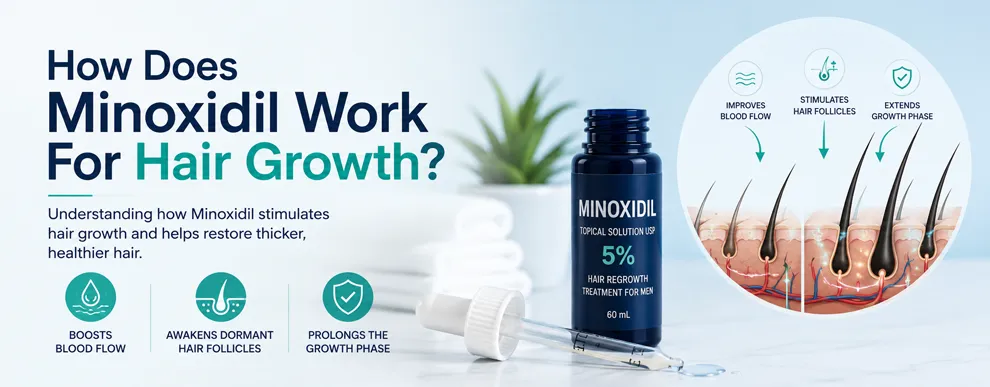
Hair loss can be frustrating, especially when you notice your hair becoming thinner or your hairline gradually receding. Fortunately, Minoxidil is one of the most extensively researched and widely used treatments for pattern hair loss. Available as a topical solution or foam in strengths such as 2% and 5%, Minoxidil has helped millions of people support hair regrowth and slow further hair loss.
But how exactly does it work?
While researchers are still uncovering every detail of Minoxidil’s mechanism, we now have a good understanding of how it helps create a healthier environment for hair growth.
Increases Blood Flow to the Scalp
One of Minoxidil’s primary actions is widening small blood vessels in the scalp, a process known as vasodilation. This improved circulation allows more oxygen and nutrients to reach the hair follicles.
Healthy hair follicles rely on a steady supply of oxygen, vitamins and minerals to produce strong, healthy strands of hair. By improving blood flow around the follicles, Minoxidil helps create the conditions needed for normal hair growth.
Although increased circulation alone does not fully explain Minoxidil’s effectiveness, it is believed to play an important role in supporting healthier, more active follicles.
Reactivates Dormant Hair Follicles
Hair naturally grows in repeating cycles:
- Anagen – the active growth phase
- Catagen – the transition phase
- Telogen – the resting phase
- Exogen – when older hairs are shed
In people with androgenetic alopecia (male or female pattern hair loss), more follicles gradually spend longer in the resting phase and produce progressively finer hairs. Over time, some follicles become dormant and may stop producing visible hair altogether.
Minoxidil helps encourage some of these dormant follicles to re-enter the active growth (anagen) phase. As more follicles begin producing hair again, many users notice their hair becoming thicker, fuller and denser with continued use.
Extends the Hair Growth Phase
In addition to encouraging dormant follicles to become active again, Minoxidil appears to help prolong the anagen (growth) phase of the hair cycle.
The longer a hair remains in this active phase, the longer and thicker it can grow before naturally shedding. This is one reason many people experience improved hair density after using Minoxidil consistently for several months.
Supports Hair Follicle Activity
At a microscopic level, Minoxidil works by influencing specialised potassium channels within hair follicle cells. This cellular activity is thought to improve follicle function and stimulate biological pathways involved in healthy hair growth.
Research also suggests that Minoxidil may increase the production of certain naturally occurring growth factors that help support the health and development of hair follicles. Although scientists continue to study these mechanisms, the overall effect is to create a more favourable environment for ongoing hair growth.
Why Does Hair Sometimes Shed at the Beginning?
Some people become concerned when they notice increased shedding during the first few weeks of treatment.
In many cases, this is a temporary and expected response.
As Minoxidil encourages more follicles to enter the active growth phase, older resting hairs are often shed to make way for new hairs. While this temporary shedding can be worrying, it is usually a sign that the normal hair growth cycle is being renewed rather than that the treatment is making hair loss worse.
How Long Does Minoxidil Take to Work?
Patience is essential when using Minoxidil.
Hair grows slowly, so visible improvements rarely happen overnight.
Typical timelines are:
- 2–8 weeks: Some users experience temporary shedding.
- 3–4 months: Early improvements in hair density may begin to appear.
- 4–6 months: Many people notice thicker-looking hair and reduced hair shedding.
- 6–12 months: Results are often more noticeable with continued consistent use.
Everyone responds differently, and some people may see results sooner or later than others.
Consistency Is the Key to Success
One of the most important things to understand about Minoxidil is that it only works while it is used consistently.
If treatment is stopped, the follicles gradually return to their previous pattern of hair growth, and any hair maintained or regrown through treatment is likely to be lost over the following months.
For the best chance of success:
- Apply Minoxidil exactly as directed.
- Use it consistently every day.
- Allow enough time before judging the results.
- Continue treatment if you wish to maintain any improvements achieved.
Is Minoxidil Right for Everyone?
Minoxidil is most effective for people experiencing androgenetic alopecia, also known as male or female pattern hair loss. It may be less effective for other causes of hair loss, such as scarring alopecia or hair loss related to certain medical conditions.
If your hair loss is sudden, patchy, associated with scalp inflammation, or accompanied by other symptoms, it is advisable to seek advice from a healthcare professional before starting treatment.
The Bottom Line
Minoxidil remains one of the most trusted and well-studied treatments for pattern hair loss. Rather than acting as a quick fix, it works by improving the environment around the hair follicle—supporting healthy blood flow, encouraging dormant follicles to re-enter the growth phase, extending the time hairs spend actively growing and promoting healthier follicle activity at a cellular level.
While results require patience and vary from person to person, consistent use gives many people the opportunity to maintain existing hair and achieve noticeably thicker, fuller-looking growth over time. For those looking to tackle pattern hair loss without prescription-only treatments, Minoxidil continues to be one of the most evidence-supported options available.